Problem CF-2113E
Statement
Marat is a native of Kazan. Kazan can be represented as an undirected tree consisting of
vertices. In his youth, Marat often got into street fights, and now he has enemies, numbered from 1 to , living in Kazan along with him. Every day, all the people living in the city go to work. Marat knows that the
-th of his enemies lives at vertex and works at vertex . He himself lives at vertex and works at vertex . It is guaranteed that . All enemies go to work via the shortest path and leave their homes at time 1. That is, if we represent the shortest path between vertices
and as (where and ), then at the moment ( ), the enemy numbered will be at vertex . Marat really does not want to meet any of his enemies at the same vertex at the same time, as this would create an awkward situation, but they can meet on an edge. Marat also leaves his home at time 0, and at each subsequent moment in time, he can either move to an adjacent vertex or stay at his current one.
Note that Marat can only meet the
-th enemy at the moments (where is the shortest path between and ). In other words, starting from the moment after the enemy reaches work, Marat can no longer meet him. Help Marat find the earliest moment in time when he can reach work without encountering any enemies along the way, or determine that it is impossible.
Constraints:
Solution
I anticipate the process of trying to explain the solution to this problem in a manner which conveys the process of me awkwardly stumbling through incorrect passages, until I happened to lay my eyes upon the obviously correct one that had lain right in front of me in a mockingly unassuming manner all this while, to be rather damaging to my ego. Consequently, I shall transport the reader to the very end of this process and spare him the assault of my fantastical ideas, some involving the use of bitsets for every path in a heavy-light decomposition of the given tree.
In problems like these, it helps to simulate the literal process unfolding with the help of your brain, with the hope of being able to glean some important/discerning information about the same.
An attempt to visualize said process will make more self-aware readers realize that at every moment, we need only concern ourselves with the following:
- The set of nodes at which the MC can be located at the
- The set of nodes upon which at least one of his enemies are located at the
Naturally, these (dynamic) sets maintain mutual exclusivity at any time
Now, even before we visualize the process, one should have a vague idea of what it would involve, namely - the blue set “greedily” expanding outwards at the beginning of every second, and the red set then negating that blueness, or claiming some nodes for its own self (some subset of which may have been blue before/after the red expansion that occurred at the beginning of this second).
Eh, I think it would be better to just formally state the rules for our simulation before we proceed.
- We begin at
- Beginning at every second
- At
- At
- At
- At
- The process ends at the earliest second when
Make of the following visualization what you will (
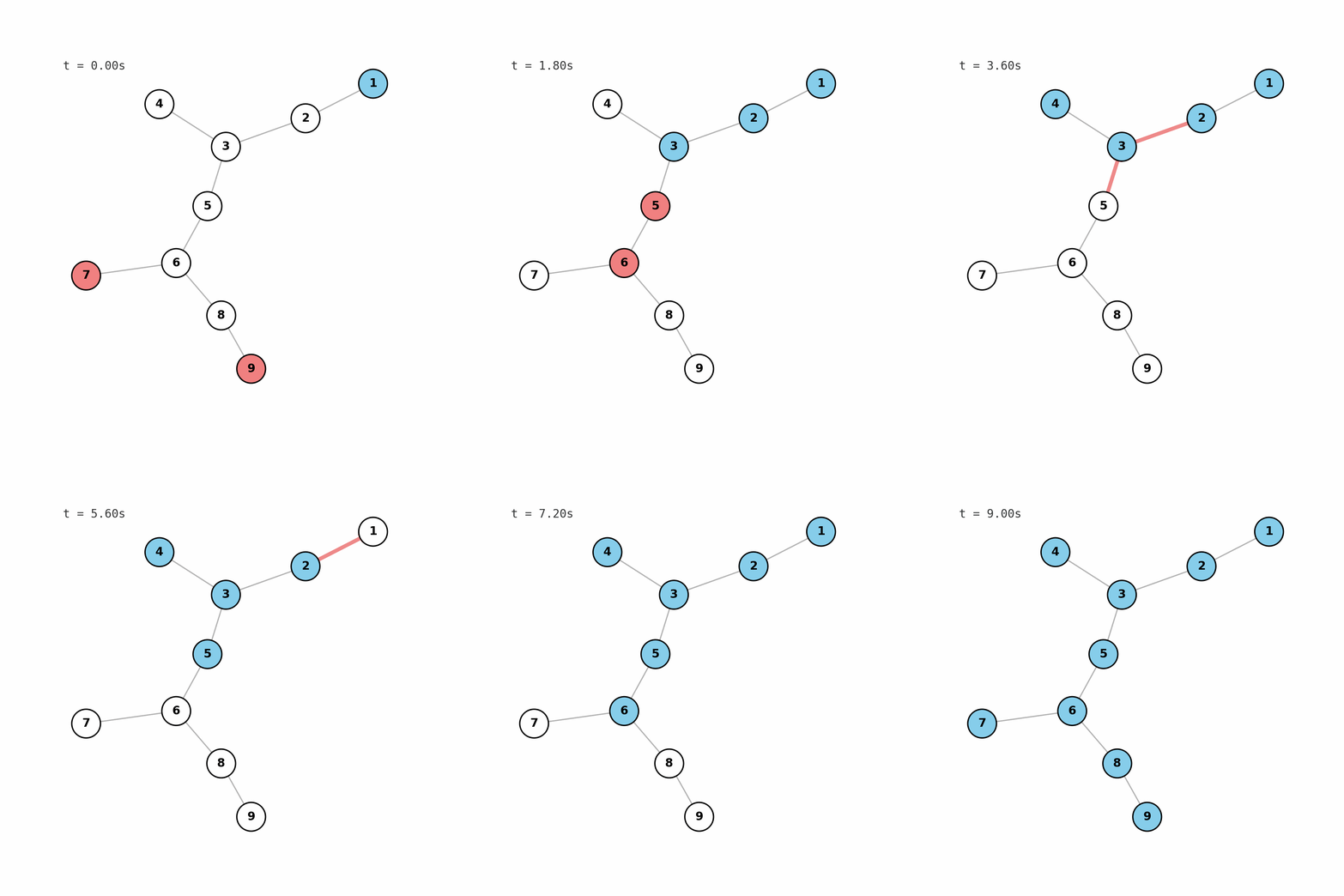
Now, if one were to try to estimate the computational expense of a literal simulation of this process, he would realize that at every second, steps 1 and 3 are cumulatively feasible to simulate (since each node is colored red a maximum of
Solving this problem reduces to understanding that/why the latter is false, and I happened to do so by modifying our system in the following manner:
- The timeline begins at
- At
- The simulation continues as usual from
Why is this modification helpful? Well, because it helps us internalize the idea that every node has a sort of "default" value of blue. Why is that helpful? Well, because if a node starts off as blue, then the number of times it's (re)claimed by the blue set is at most the number of times it was snatched away by the red set, and the latter corresponds to steps 1 and 3, which are tractable (so any blue node becomes red at most ~
Also note that this modification at
A concrete solution now begins to assume form:
start with B = {x} and R = {whatever}
ans = -1

for t from 0 to 2 * n:

	for every enemy:
		vacate its red node, move it onto an edge/kill it

	for every non-blue node that's adjacent to a blue node:
		make it blue

	for every enemy:
		color the next node (potentially blue) in its path red

	if y is blue:
		ans = t
		stop
The only thing that remains is to figure out how to efficiently iterate over non-blue nodes that are adjacent to a blue node at the
Well, upon closer inspection, we realize that any node
- Some node adjacent to
Notice that we didn't enforce the requirement of being next to a blue node in the first case (unlike the second), this condition simply constitutes a large, convenient net we cast upon a search space, and we shall now pay the cost for potential overcatch by actually having to check for blue neighbours. This turns out to not be very punishing, as we can go over all red nodes at time
Let's now consider the second condition. For every node
We finally have the following solution:
start with B = {x} and R = {whatever}
ans = -1

for t from 0 to 2 * n:

	for every enemy:
		vacate its red node, move it onto an edge/kill it

	to_be_made_blue = {}
	for every node u that was red at time t:
		if any neighbour v of u is blue:
			put u into to_be_made_blue
	for every node u that was made blue at time t - 1 + 0.66:
		if u is still blue:
			for every neighbour v that's not blue:
				put v into to_be_made_blue
	for every node u in to_be_made_blue:
		make it blue

	for every enemy:
		color the next node (potentially blue) in its path red

	if y is blue:
		ans = t
		stop
I shall spend no more time yapping about additional implementation details as I'm sleepy. Here is code if you want some.
Finally, our solution runs in
It's 5:19 AM and I'm really comfortable in my bedrot fortress, perhaps to a point where the foggy complacence induced by this leisurely state has made the blog really bad.